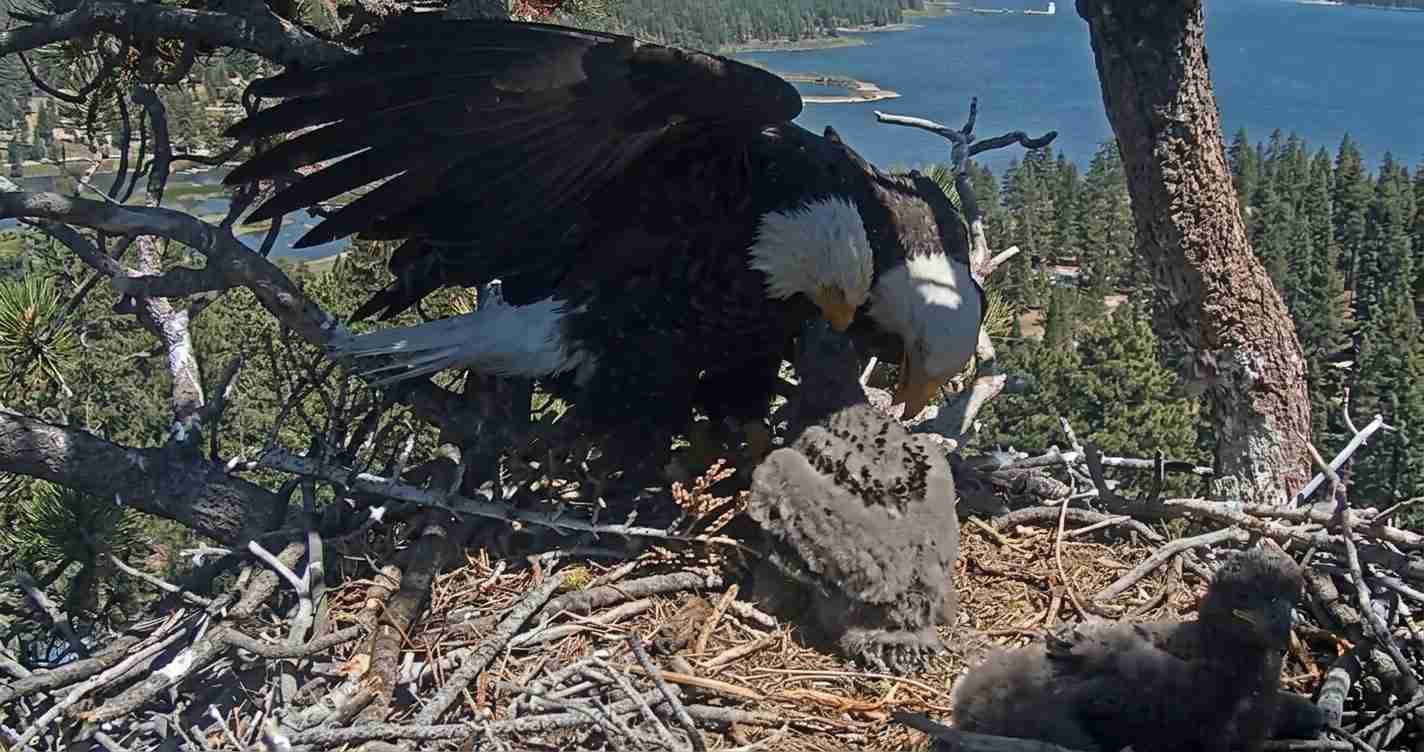
Big Bear eaglets named Sandy and Luna as community honors longtime eagle-cam leader
Big Bear Lake’s eagle pair Jackie and Shadow have named their 2026 eaglets Sandy and Luna after a public submission drive and a vote by local third-graders through Friends of Big Bear Valley, honoring community participation and a longtime leader.
- Two chicks hatched April 4–5, 2026 and were named Sandy and Luna following a community naming campaign and classroom vote.
- Nearly 64,000 name submissions produced 30 randomly selected ballot names; third-graders cast the final votes (Sandy 30, Luna 25).
- “Sandy” honors Sandy Steers, the late FOBBV executive director who launched the eagle cam in 2015.
- Live stream and citizen science: the nest cam on YouTube provides 24/7 viewing and supports education and fundraising.
Naming process and community involvement
Friends of Big Bear Valley (FOBBV) ran a naming fundraiser that doubled as a public name drive, collecting nearly 64,000 submissions. From that pool, FOBBV randomly selected 30 gender-neutral names for ballots presented to local third-grade classrooms. Students voted and chose Sandy and Luna as the official names for Jackie and Shadow’s 2026 eaglets.
The ballot names were kept gender-neutral because the chicks’ sexes are not yet known, and the classroom vote continues a local tradition linking conservation to school-based learning. Runners-up included Star, Chip and Phoenix; other ballot options included Windy, Kazoo, River and Hazy.
A tribute to Sandy Steers
The name Sandy carries deep local meaning. Sandy Steers, the longtime FOBBV executive director who launched the Big Bear eagle cam in 2015, died in February 2026 after a battle with cancer. FOBBV reported that “Sandy” was the most popular submission, appearing in 3,706 of 63,915 entries. FOBBV said Steers likely would have preferred against a direct naming but would be honored by the community’s choice.
“She helped turn a single camera into a worldwide window on nesting eagles.”
How to tell Sandy and Luna apart
FOBBV staff and volunteers watching the live stream note early differences: Sandy (hatched April 4) appears larger with a bigger head and neck and a slightly curved gape, and has been described as more submissive. Luna (hatched April 5) is smaller and has shown relatively more aggressive behavior in early interactions. FOBBV cautions these signs are subtle and may change as the chicks grow.
Growth and early life
Each chick weighed roughly 2 ounces at hatching and has rapidly grown to nearly 3 pounds, reflecting typical raptor development. This rapid growth requires frequent feedings and constant parental care from Jackie and Shadow as feathers and coordination develop toward fledging.
Live access and public interest
The nest cam streams 24 hours a day on YouTube, allowing a global audience to follow daily routines, feeding events and sibling interactions. The stream serves as an educational tool, a fundraising platform for FOBBV, and an informal citizen science feed where viewers help spot behavior and milestones.
Watch the live stream at FOBBV YouTube live camera.
Context and recent history
Since the camera began streaming in 2015, Big Bear’s nest has attracted steady attention. Last season’s eaglets were named Sunny and Gizmo after a similar community process, which also included the loss of one chick. These naming traditions and the realities of raising wild raptors create teachable moments about wildlife life cycles and conservation.
Funding, education and citizen science
The naming drive functioned as a fundraiser, demonstrating strong public interest and donor engagement. Involving schoolchildren strengthens ties between conservation organizations and classrooms, providing hands-on environmental education. The live cam functions as a global classroom and a citizen science tool that helps monitor behavior and potential threats.
Implications for The World
This local naming event illustrates how digital tools and live streaming amplify local wildlife stories globally, raising funds and broadening conservation education. Engaging children in naming and voting builds early conservation stewardship, while tributes to leaders like Sandy Steers show how individual projects can have lasting international impact.
Sources and further reading
- ABC7: Big Bear eaglets officially have names Sandy and Luna
- LAist: Sandy and Luna named for Big Bear Bald Eaglets
- Popular Science: Jackie and Shadow eaglets named Sandy and Luna
- VVNG: Big Bear eaglets named Sandy and Luna following community vote
- FOBBV YouTube live camera
Key facts preserved from reporting: chicks hatched April 4 and 5, 2026; nearly 64,000 name submissions (30 ballot names); third-grade vote results (Sandy 30, Luna 25); Sandy honors Sandy Steers; early behavioral and growth observations reported by FOBBV.