Jackie and Shadow lay new egg after raven attack destroys earlier clutch — Big Bear’s famed eagle cam draws global viewers
A new egg appeared in Jackie and Shadow’s Big Bear Lake nest at about 2:30 p.m. on Feb. 24, after ravens destroyed an earlier clutch on Jan. 30 — Friends of Big Bear Valley’s live cams drew thousands of viewers worldwide.
Key takeaways
- New egg observed Feb. 24: FOBBV Eagle Cams captured Jackie standing to inspect the egg before settling back on it.
- Earlier clutch lost: Two eggs laid Jan. 23 and Jan. 26 were destroyed during a raven attack on Jan. 30 — see Recap videos and FOBBV updates.
- Incubation window: Bald eagle eggs incubate about 35 days; continuous brooding could put a possible hatch in late March (see FOBBV live stream and recaps).
- Global audience and conservation: The FOBBV channel streams the nest 24/7, serving education, outreach and community monitoring.
Nest history and recent events
Location and background: Jackie and Shadow’s nest sits on a valley slope overlooking Big Bear Lake and has been monitored closely by the Friends of the Big Bear Valley (FOBBV) cams. The pair lost two eggs on Jan. 30 when ravens attacked the unguarded nest and broke the eggs while the adults were away; viewers worldwide watched FOBBV updates and recaps documenting the loss (Recap videos and FOBBV updates).
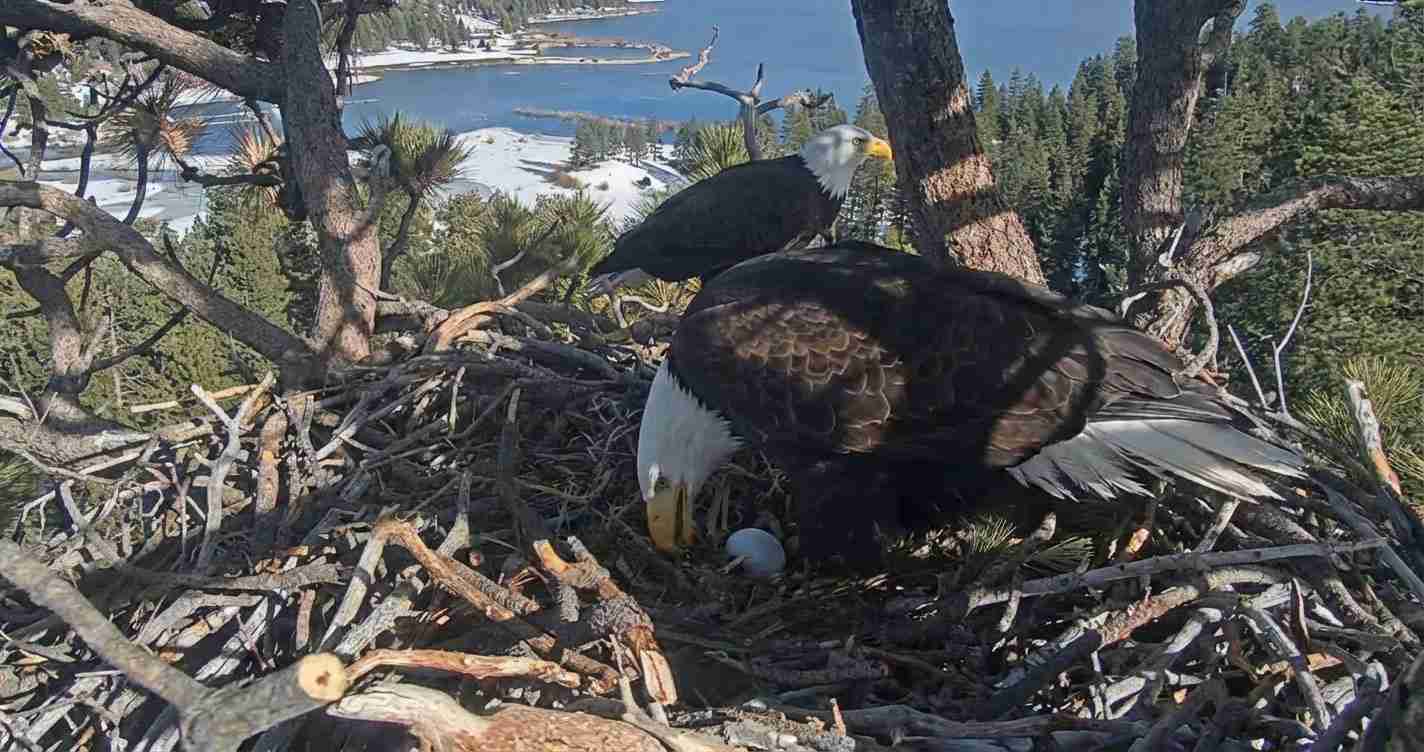
Hope renewed: Less than four weeks after the loss, cameras captured a hopeful moment: at about 2:30 p.m. on Feb. 24 Jackie stood, inspected a newly laid egg visible on Cam 1, then settled back onto it. Shadow returned shortly afterward. Observers noted clear skies and mild mid-50s temperatures that afternoon, with a recent snow blanket melted to clear the view for streaming viewers (FOBBV Eagle Cams).
Behavior observed on the cams
FOBBV’s Cam 1 (primary nest cam) and Cam 2 (wide view) recorded a range of nesting behaviors this month: courtship, nest maintenance, food disputes and vigilance against scavengers.
- Feb. 21: After evening nestorations Jackie vocalized readiness for mating and nibbled Shadow’s neck — a common pre-mating behavior — before mating later behind branches (live footage).
- Feb. 12–13: Jackie delivered sticks and straw while Shadow made fly-bys and brought a whole fish; a spirited tug-of-war followed, with Shadow maintaining a meal despite Jackie’s mantling attempts (recap footage).
- Viewers have documented Jackie’s repeated deliveries of bulky sticks, careful grooming of white tail feathers, mutual “goodnight chortles,” and alertness for ravens — an ongoing threat at this site (highlights and ID footage).
“The cameras provide real-time insight into nesting life and threats, allowing community vigilance and scientific observation.”
Who are Jackie and Shadow?
Jackie (female): Unbanded, resident since at least September 2016; hatch year estimated around 2012. Recent footage shows a small, faint spot on her forehead used for identification (identification video).
Shadow (male): Unbanded, present at the Big Bear nest since May 2018; hatch year estimated around 2014. He is sometimes identifiable by grayish feathers on the left side of his white tail in some views (identification video).
The pair is notable for cooperative parenting, vocal communication and consistent nest maintenance.
Cameras, community and conservation
The Friends of the Big Bear Valley maintain 24/7 livestreaming nest cams to engage a global audience with recaps, commentary and short videos. The FOBBV channel and social accounts — YouTube, Instagram (FOBBV cam channel), Facebook (FOBBV), and TikTok — are hubs for footage, identification notes and community discussion.
The cameras support public outreach, education and informal monitoring of nesting success while helping local conservationists track risks such as raven predation and human disturbance. Since the first recorded chick hatched in 2012, the Big Bear Valley has seen about a dozen eggs laid, fewer hatching and reaching maturity; nationally roughly half of eaglets survive to adulthood, underscoring protection needs (historical context and highlights).
Community response and tributes
FOBBV’s livestream attracts thousands of viewers. The Jan. 30 egg loss prompted immediate, heartfelt reactions; at the same time, the pair’s rapid nest repairs and resumed courtship were taken as signs of resilience. Recent recaps honored the late Sandy Steers for community-building and promoted the BKind22 ethos of kindness in conservation outreach (community videos and tributes).
Investigative perspective: unanswered questions and what to watch
- Incubation continuity: Watch for consistent brooding; 35 days is typical so continuous incubation and predator defense matter (FOBBV live feed).
- Raven pressure: Ravens destroyed earlier eggs; monitoring patterns of raven activity and non-harmful deterrents is important (recap).
- Nest stability: Jackie and Shadow’s additions may change nest shape and vulnerability; continued documentation will indicate whether intervention is needed (nest footage).
- Hatching and fledging odds: Even with a successful hatch, historical data show not all chicks fledge; parental provisioning and growth tracking will be key (historical context).
Implications for the world
Economic impact: The live cams boost Big Bear’s visibility, inspiring tourism, donations and support for local conservation work.
Political consequences: Local attention highlights policy questions about habitat protection, predator management and funding for conservation programs that safeguard nest sites.
Social and cultural effects: The livestream fosters a global community around wildlife stewardship; Jackie and Shadow have become symbols of resilience and continuity for many viewers.
Practical applications: Real-time monitoring allows scientists, educators and the public to observe behaviors like mating, nestorations and feeding without disturbing the birds — a model for combining education with conservation (streaming access and educational content).
Sources and further viewing
- FOBBV Eagle Cam live footage and highlights
- FOBBV recap and behavioral highlights
- Identification and bonding footage for Jackie & Shadow
- FOBBV YouTube channel (year-round access)
Reporting includes review of FOBBV livestreams and public recaps. Times Media Service provided field notes and community reporting from Big Bear, California.