
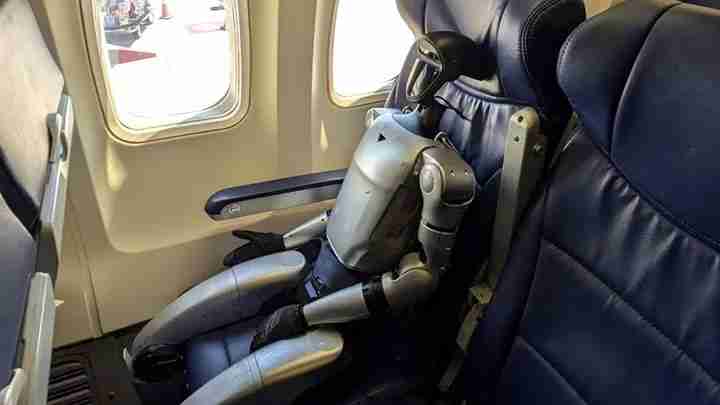
Southwest Airlines flight delayed after 4-foot humanoid robot “Bebop” has oversized battery removed
Oakland to San Diego flight was held about an hour April 30, 2026, when a 4-foot humanoid robot named Bebop had an oversized lithium battery removed at the gate under airline and TSA safety rules.
Key takeaways
- Flight delayed: Southwest Flight 1568 (Oakland → San Diego) was delayed about one hour after gate staff removed a battery.
- Device: Bebop, a 4-foot humanoid robot (≈70–75 lbs) owned by Elite Event Robotics, exceeded carry-on weight limits with its case.
- Battery issue: Crew determined the lithium battery exceeded airline limits and it was confiscated per safety protocols.
- Operational impact: Handler bought an extra seat and later arranged overnight shipping of the battery so Bebop could continue its appearances.
Main content
Flight and device details
Flight: Southwest Airlines Flight 1568, Oakland to San Diego, April 30, 2026.
Device: Bebop, a 4-foot-tall humanoid robot rented by Elite Event Robotics of Dallas, Texas, reported at about 70–75 pounds together with its hard transport case.
What happened at the gate
Passengers at Oakland airport reported Bebop drew a crowd, dancing and interacting with children who gave it high-fives while many recorded videos and photos. Elite Event Robotics said the robot and its case exceeded Southwest’s 100-pound carry-on policy, so the handler purchased an extra seat and registered Bebop as an inanimate item to secure it in a window seat.
After boarding, airline employees identified that Bebop’s lithium battery exceeded the allowable size and requested that it be removed for safety reasons. The resulting battery removal delayed pushback by roughly one hour, according to airline and company accounts.
Why the battery mattered
Lithium batteries pose an onboard fire risk if damaged, shorted or improperly packaged. Transportation Security Administration guidance and airline policies set specific watt-hour limits and handling rules for batteries. When crew determined Bebop’s battery exceeded allowable limits, they asked for its removal; the battery was confiscated, and the flight departed about an hour later.
For official guidance, see the TSA guidance on lithium batteries.
Elite Event Robotics’ account of the delay
Eily Ben-Abraham, an Elite Event Robotics employee, told Fox News Digital the team first discovered the weight issue while preparing to board. After buying the extra seat and boarding Bebop, crew raised concerns about the battery. Ben-Abraham said he removed the battery at the airline’s request and was directed to contact the airline’s confiscation department.
Ben-Abraham said Bebop had flown earlier the same day from Dallas to Oakland without battery problems. Family members then drove over five hours to retrieve the battery and overnighted it to a hotel in Chicago so Bebop could appear at the scheduled event. Elite Event Robotics later posted on social media:
“Delayed… but worth the wait. Bebop finally made it on board, and safe to say he’s still the main attraction wherever he lands”
and shared the update on Elite Event Robotics Instagram.
Passengers’ reactions and public debate
Reactions ranged from amusement to frustration. Some travelers enjoyed the spectacle and posted videos; others objected to a robot occupying a paid seat. One social media commenter wrote: “That’s not a passenger, that’s freight.” A media-cited passenger reported missing a connecting flight and called the episode a “publicity stunt.”
Southwest emphasized adherence to safety protocols, noting the customer had purchased a seat for the device but that the battery exceeded allowable size limits and had to be removed. The airline praised its crew’s professionalism and reiterated that passenger and employee safety is the priority in its statement to Fox News Digital and other outlets.
Regulatory context: Flight lithium battery rules
Airlines and regulators impose watt-hour limits and special handling rules for lithium batteries because of fire hazards. Policies cover how spare batteries must be carried (typically in carry-on with terminals taped), when large batteries are prohibited, and when batteries must travel as checked or cargo shipments. Enforcement and specifics can vary by carrier and aircraft type.
For TSA specifics, consult the TSA guidance on lithium batteries.
Logistical implications for event operators
The incident underscores the need for event operators to:
- Verify battery specs: Check watt-hour ratings and airline policies well in advance.
- Consider shipping: Ship batteries separately via compliant cargo services for hazardous materials when necessary.
- Travel without batteries: Plan for devices to travel powered down and without batteries if feasible.
- Document specs: Carry documentation to speed gate checks and avoid last-minute delays.
Elite Event Robotics said Bebop will continue to fly commercially but will avoid onboard batteries for similar legs going forward, per company remarks shared with media.
Implications for the World
Economic impact: The episode spotlights costs and schedule risks for event, entertainment and robotics firms transporting large electronic devices, including potential confiscation, fines or missed appearances affecting revenue and reputation.
Political and regulatory consequences: Regulators may clarify guidance on extra seats for non-human devices and reinforce staff training on battery limits. Policymakers could review whether rules clearly address inanimate “passengers” such as robots.
Social and cultural effects: As humanoid robots become more common in public, cultural norms about interacting with machines will intersect with transport policies. Airports and airlines may need clear protocols balancing public interest and safety.
Practical applications for travelers and operators
- Verify airline carry-on weight limits and battery restrictions well before travel.
- Ship high-capacity batteries via approved cargo channels when required.
- Travel with devices powered down and without batteries when possible, and carry documentation of battery capacity.
- Budget extra time at airports for screening and potential inspections.
Sources and further reading
Reporting and statements referenced in this article include coverage and interviews with Elite Event Robotics employee Eily Ben-Abraham by Fox News Digital, a Southwest Airlines statement provided to media (see Southwest Airlines), Elite Event Robotics social media posts on Elite Event Robotics Instagram, and official TSA guidance on lithium batteries.


