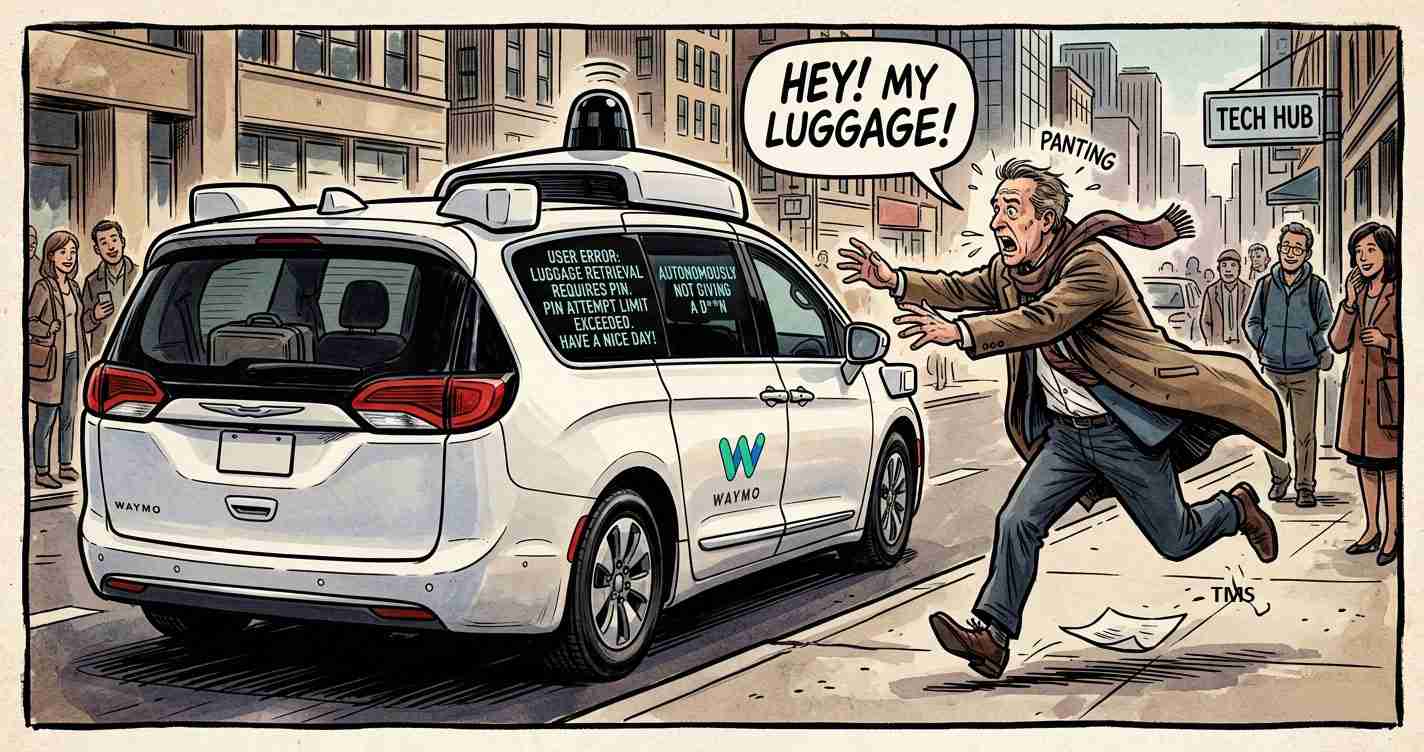
Waymo robotaxi leaves passenger stranded at SJC after trunk won’t open, raising questions about driverless car airport procedures
A Waymo robotaxi reportedly drove off from San José Mineta International Airport with passenger Di Jin’s suitcase in the trunk after trunk commands failed, raising questions about driverless car procedures and lost-item responsibilities at busy airports.
- Passenger: Di Jin says his suitcase remained in the trunk after the vehicle departed.
- Immediate response: Waymo located the bag at a depot but initially offered no shipping coverage before agreeing to pay after a dispute.
- Policy tension: Waymo’s help pages say trunks open automatically at trip end, yet the company’s lost-item policy limits responsibility and reimbursement.
- Airport operations: Busy curbside rules and automated trip-end logic can complicate rapid recovery when hardware or app commands fail.
What happened at the airport
According to reporting sourced to a technology commentator known as CyberGuy, Di Jin’s ride from Sunnyvale to San José Mineta International Airport (SJC) appeared routine until he exited the vehicle at the terminal and could not open the trunk.
Jin says he pressed the physical trunk release above the license plate and tapped “Open trunk” in the app; neither worked. The car then drove away with his suitcase still inside.
He called Waymo customer service immediately and was told the vehicle was already en route to a company depot and could not be turned around, according to the account.
Waymo later emailed to say the luggage had been secured at a depot. The company initially offered to either ship the luggage without covering shipping costs or provide two free rides to collect it in person. After Jin pushed back, Waymo agreed to pay shipping and the bag was returned.
Source note: The detailed account appears in CyberGuy reporting; Waymo did not comment directly to that reporter on the specific incident. The company’s help pages and lost-item policy are available at Waymo.com.
Why the trunk may have failed
Waymo’s rider help pages explain trunk access options: press the trunk release button above the license plate, tap “Open trunk” in the app, or rely on the trunk to open automatically when the trip is officially ended.
The company notes the trunk may not open if a rider exits before the vehicle has fully pulled over and the trip is marked finished in the system. Those operational details could explain how a passenger finds the trunk closed even after pressing the button.
See Waymo’s guidance at Waymo.com for the official description of trunk behavior and rider controls.
Waymo’s lost-and-found rules
Waymo’s lost-and-found guidance says the company will try to reunite riders with items left in a vehicle but does not guarantee recovery, immediate delivery, undamaged return, or reimbursement for item value. The policy explicitly states Waymo is not responsible for items left after a trip ends.
That policy is central to Jin’s dispute: when hardware or app issues prevent timely retrieval, riders can be left bearing the burden of recovery unless the company chooses to make exceptions. The policy text is available at Waymo.com.
How common are airport issues with robotaxis?
The specific trunk incident has not been widely confirmed in major national outlets based on available searches. The detailed account cited here originates from CyberGuy reporting and lacks a public Waymo statement tied to the same facts.
Nevertheless, airports are a frequent focus as Waymo expands robotaxi service. Publications such as TechCrunch have covered Waymo’s airport rollouts and the operational hurdles those expansions can face.
Airport curbside conditions—busy traffic, time-limited stops, and strict rules—compound the challenge: a remote team or depot may be unable to reverse a trip quickly while a passenger stands at the curb.
Safety and trust concerns
Driverless rides can feel unnerving for passengers who are used to drivers intervening in tricky moments. Stories like Jin’s—watching a vehicle drive off with luggage and no driver to flag down—amplify those anxieties.
Waymo publishes safety data showing fewer serious crashes in its operating areas, and there are videos of successful airport drops online. Yet incidents affecting personal belongings and basic trunk or door functions tend to erode confidence faster than data can restore it.
Examples of autonomous taxi airport interactions are visible in online videos; see YouTube (video) and YouTube (video) for both smooth and problematic examples.
Reporting and verification
The Jin account appears to originate with CyberGuy reporting and has not been independently verified in major wire services or national outlets. Searches did not surface matching coverage in Reuters, The New York Times, The Wall Street Journal, or TechCrunch for this specific passenger report.
Readers should note that while Waymo’s policies can explain how a trunk might not open, independent confirmation of every step in the account is limited to the sources cited above and Waymo’s public help pages at Waymo.com.
Legal and service implications
Wording that limits responsibility for lost items is common among rideshare and transport providers. But when company hardware or software prevents a passenger from retrieving property at the curb, the language matters.
If trunk buttons or app commands fail, customers may expect rapid remedies and company-covered return shipping. How operators handle such incidents will influence consumer acceptance and may attract regulatory scrutiny if similar complaints accumulate.
Implications for The World
Economic impact
Airport transfers generate significant short-trip revenue. If travelers lose trust in robotaxi reliability for airport trips, ridership could lag and slow revenue growth for autonomous fleets. Operators may need to increase staffing, raising costs and reducing expected savings.
Political consequences
Regulators in other countries monitor U.S. rollouts. Operational gaps highlighted by incidents could prompt tighter rules for curbside access, equipment redundancy, or passenger protections, affecting approval timelines and liability standards.
Social effects
Travelers on tight schedules—business travelers, older passengers—may become wary. Simple, relatable problems like a bag left behind resonate widely and can slow adoption even if most trips are uneventful.
Cultural relevance
In places with trusted rail and taxi systems, autonomous cars must prove added convenience without new risks. A suitcase left at an international airport is a clear, relatable issue that can erode confidence across demographics.
Practical applications
- Operators should make trunk access and trip-end behavior clearer in apps and at pickup prompts.
- Airports and operators might coordinate to station a human attendant for final trunk checks at busy terminals.
- For travelers: keep essentials with you, allow extra time, and confirm the trip shows as fully ended in the app before walking away from the vehicle.
Sources and further reading
- Waymo.com — official site and rider help pages
- TechCrunch — coverage of Waymo airport launches
- YouTube (example video) and YouTube (example video) — autonomous airport drops and tests
- Reporting on the passenger’s account as covered by CyberGuy (original reporting contact noted by sources)
Reporting by Times Media Service