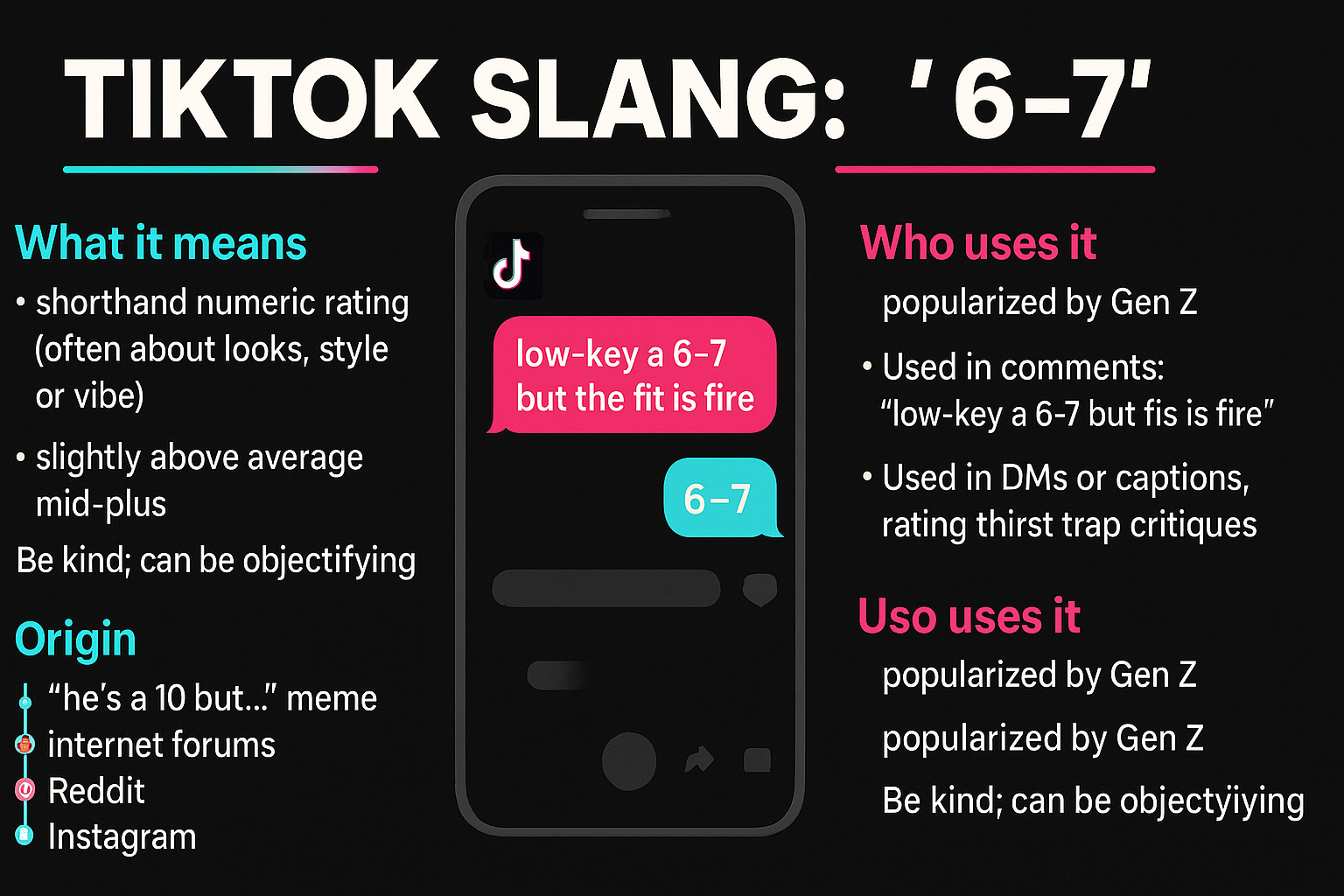
What “6-7” Means — The TikTok Slang From Skrilla’s “Doot Doot (6 7)” and How Gen Z Made It a Viral Inside Joke
The internet is buzzing with a cryptic phrase: “6-7.” Originating from Skrilla’s “Doot Doot (6 7)” and amplified by TikTok basketball edits, it has become a playful, intentionally vague inside joke among Gen Z and Gen Alpha.
Key takeaways
- Origin: The phrase began as a hook in Skrilla’s late‑2024 track and exploded online in early 2025.
- Spread: TikTok edits, memes and a viral AAU clip known as the “6‑7 Kid” pushed the phrase into youth culture.
- Meaning: Intentionally ambiguous — 6‑7 functions as a playful, in‑group signal rather than a fixed term.
- Local relevance: Colusa schools and families are advised to treat the term as harmless and use it to teach digital literacy and safe posting.
Origins: Skrilla, the song hook and early edits
The story begins with music. Rapper Skrilla released “Doot Doot (6 7)” in late 2024; the song’s repeating numeric hook proved easy to clip and reuse as a short audio bite. Early listeners on short‑form platforms made those clips into reusable soundbites and edits. See Wikipedia: 6-7 (meme) for a timeline of the meme’s rise.
How TikTok turned a lyric into a trend
On TikTok, audio snippets act as currency. Creators paired the “6‑7” hook with basketball highlights (especially clips featuring players around six‑foot‑seven), staged skits, and punchline reactions. A viral AAU clip — often called the “6‑7 Kid” — featured an exaggerated shout that was remixed and distributed widely, moving the phrase from audio hook to social shorthand. Reporting on the trend documents this spread across platforms; see the North Jersey explainer: What to know about 67 slang on TikTok.
What “6‑7” actually means — and why its ambiguity matters
Across sources, a consistent theme appears: 6‑7 has no deep or stable denotation. Instead, it echoes earlier number‑based viral hooks (think Vine’s “21” or Fetty Wap’s “1738”) and serves as a marker of in‑group recognition rather than a literal code.
“The emptiness is deliberate — ambiguity makes the phrase remixable and broadly usable as an inside joke.”
Common ways users apply “6‑7”:
- As captions or hashtags on TikTok and Instagram Reels.
- As a playful greeting or hallway shout among students.
- As a non sequitur or reaction in group chats, Discord servers, and Snapchat stories.
- In meme challenges riffing on repeating an action “six to seven times” for comedic effect.
Who is saying “6‑7”? Demographics and platforms
Primary users are teens and Generation Alpha who frequent short‑form video apps. While TikTok was the launchpad, the phrase spread quickly to Instagram Reels, Snapchat, Discord and text messages. Most reporting indicates limited long‑term adoption among older adults; news outlets have mainly documented the trend to inform parents and teachers. See explainer resources such as Parade: What Does 6‑7 Mean? and FindMyKids: What Does 6‑7 Mean? for context on use and audience.
Contextual uses and cultural parallels
Viral numbers have precedent. Simple numeric hooks from songs or clips became shared references in the past; 6‑7 follows that pattern: catchy musical hook + remix culture + youth audience = meme. The phrase’s vagueness is a feature, not a bug — it creates flexible cultural currency.
Investigative notes on origin claims
Some online write‑ups speculate about geographic nods (for example, references to 67th Street). These claims remain largely speculative; our review finds no authoritative confirmation that Skrilla intended a specific location or meaning. The most reliable narrative is simple: a repeated lyric was easy to clip and remix, which enabled rapid spread (see Wikipedia: 6-7 (meme)).
How schools and parents are seeing it
Teachers and parents encounter 6‑7 as a greeting, caption or inside joke among students. Reactions among adults range from bemused to curious. The phrase itself is not linked to harmful activity; local news coverage has aimed to explain the trend so adults can discuss online culture with kids. Use such moments to teach digital literacy, consent in sharing, and safe posting practices (FindMyKids explainer).
Implications for Colusa, California
Schools and teachers: Colusa Unified staff may see 6‑7 in hallways or on phones. Responses should prioritize digital literacy and discussion over punishment.
Parents and families: Ask children what the phrase means to them. Open, curious conversations are more effective than punitive reactions. Reference local explainers and national write‑ups for context.
Youth programs and coaches: Local AAU and school basketball programs may notice the trend in posts or chants. Coaches should remind athletes about sportsmanship and privacy when sharing videos.
Local media and community outlets: Use coverage of 6‑7 to educate older readers about how online slang forms and spreads.
Safety and etiquette: Although the phrase is not harmful, platforms that spread it may contain risky behavior. Encourage permission before sharing others’ videos, awareness of personal information, and reporting harassment.
Sources and reporting
This article draws on contemporary reporting and compiled summaries of the meme’s rise, including:
- Wikipedia: 6-7 (meme)
- Parade explainer: What Does 6‑7 Mean?
- FindMyKids explainer: What Does 6‑7 Mean?
- NorthJersey: What to know about 67 slang on TikTok
This reporting aims to help Colusa readers identify the phrase, understand where 6‑7 came from, and consider simple, practical responses in schools, homes and community spaces.