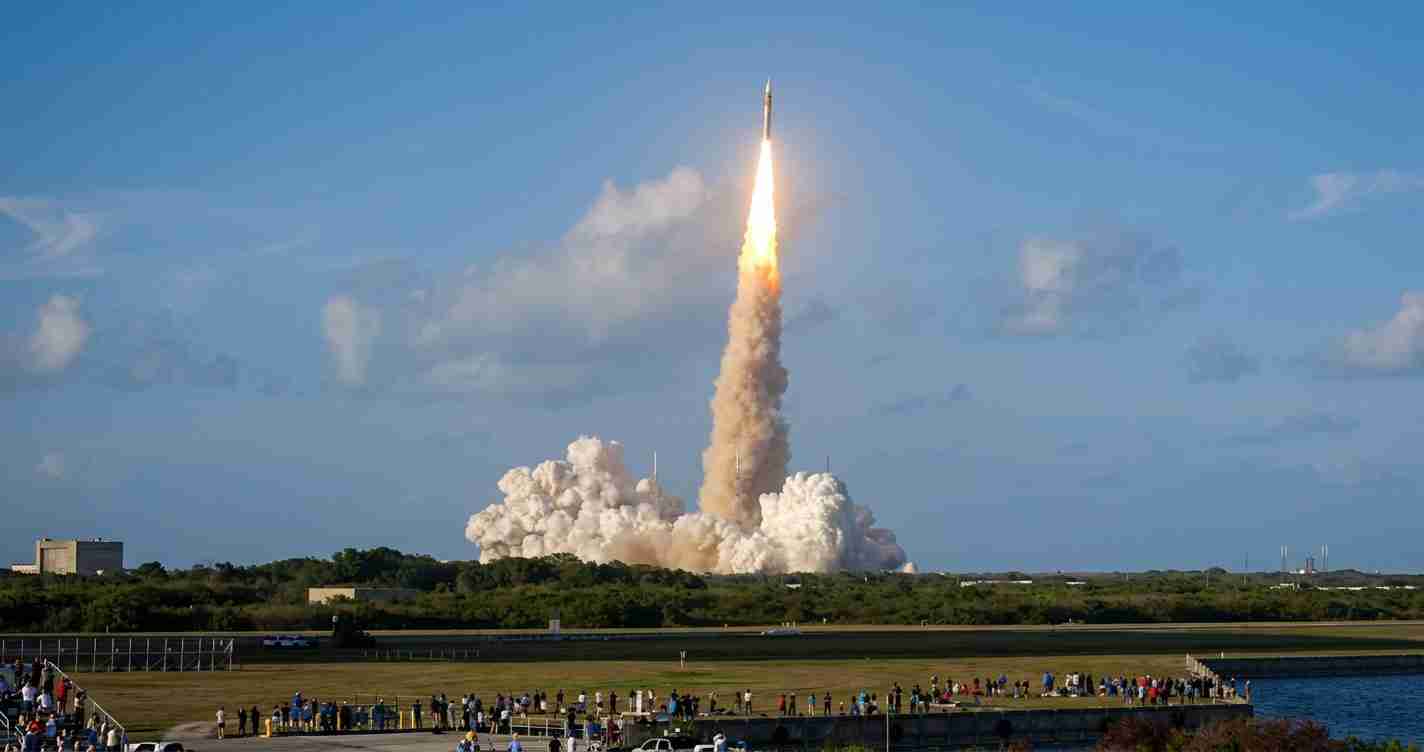
Humans return to lunar space: Artemis II lifts off from Kennedy in a test of NASA’s deep‑space systems
NASA’s Artemis II launched April 1, 2026, at 6:35 p.m. EDT from Kennedy Space Center, beginning a 10‑day crewed free‑return mission around the Moon to test the SLS rocket and Orion spacecraft’s deep‑space systems for future lunar landings.
Key takeaways
- Launch: 6:35 p.m. EDT, April 1, 2026, from Launch Complex 39B at Kennedy Space Center — see the Kennedy Space Center event page.
- Crew: Commander Reid Wiseman, Pilot Victor Glover, Mission Specialists Christina Koch and Jeremy Hansen — details on the NASA Artemis II mission page.
- Mission: A 10‑day free‑return flight around the Moon, reaching roughly 8,000 km above the lunar surface to validate SLS and Orion systems for later Artemis landings.
- Public tracking: Live telemetry and updates available via NASA’s launch‑day coverage — see NASA launch day updates.
Main story
Launch details and mission overview
Kennedy Space Center, Florida — Times Media Service. At 6:35 p.m. EDT on April 1, 2026, the Space Launch System (SLS) lifted off from Launch Complex 39B carrying the Orion crew module and four astronauts on the Artemis II mission. The 10‑day flight is a crewed free‑return test that will take Commander Reid Wiseman, Pilot Victor Glover, and Mission Specialists Christina Koch and Jeremy Hansen farther from Earth than any human mission to date.
This flight is a critical validation of hardware and procedures that will support future lunar landings and, ultimately, ambitions to send humans to Mars. For official mission context, see the NASA Artemis II mission page and the Kennedy Space Center event page.
The launch and the lift‑off sequence
At T+0 the SLS cleared the pad and climbed through clear Florida skies. The rocket accelerated through supersonic speeds; the core stage completed its burn in roughly eight minutes before separating and descending back toward Earth. The upper stage carried Orion and its crew into a high Earth orbit for initial system checks.
NASA teams scheduled additional upper‑stage burns over the next hours to place Orion into the planned high Earth orbit. For about one day, the crew will run through checks of life support, navigation and communications before committing to the translunar injection burn that sends Orion on its free‑return path toward the Moon. Follow live updates on NASA launch day updates.
Crew, milestones and historic firsts
The four‑member crew is both international and historic. Reid Wiseman commands the flight. Victor Glover and Christina Koch are NASA veterans; Glover is the first person of color and Koch the first woman to travel beyond low Earth orbit on a crewed mission. Jeremy Hansen represents the Canadian Space Agency, underscoring international partnership on Artemis II.
“A beautiful moonrise,” Commander Wiseman said minutes after liftoff, describing the view as Orion climbed away from the Atlantic. Planetary scientist Paul Byrne, who watched from about 17 kilometers away, said he was “shaking still because of the adrenaline.” Lindy Elkins‑Tanton called the crew dynamic “the most inspiring part” of the mission.
Why this flight matters: technical tests and trajectory
Artemis II is a test flight — not a landing. Its goals are explicit: demonstrate reliable crewed liftoff and staging of the SLS rocket, and prove Orion’s life‑support, propulsion, navigation and communications systems under real deep‑space conditions. The spacecraft follows a free‑return trajectory, looping behind the Moon and returning to Earth without entering lunar orbit, with a planned closest approach of roughly 8,000 km above the lunar surface.
If nominal, the crew will reach the mission’s farthest point from Earth on day six. NASA also noted there is a chance astronauts could witness a solar eclipse while Orion is behind the Moon — a rare view that would exercise Orion’s cameras and sensors under eclipse conditions. Technical context and expectations are summarized by the Planetary Society overview.
Delays, checks and safety questions
The launch slipped from an earlier February window after engineers discovered hydrogen fuel leaks and a helium‑feed issue on the upper stage. Those problems required additional inspections, repairs and repeated testing before a Flight Readiness Review set April 1 as the new target.
Open investigative questions remain: how durable are the hydrogen‑leak fixes over repeated cycles, and have suppliers corrected flow‑control reliability for the upper stage? NASA has stated teams completed thorough inspections before flight, but engineers worldwide will scrutinize telemetry as Orion’s systems operate in real time.
Public access, transparency and oversight
NASA encouraged public engagement and transparency. Viewers can follow telemetry and position data via the launch day blog and live updates, and through NASA’s mobile app and Artemis real‑time tracking tools. Experts emphasize that clear, timely disclosure of failures, fixes and anomalies will be crucial to sustaining public trust in the multi‑billion‑dollar Artemis program.
Costs, partners and the road ahead
Artemis II validates hardware and procedures that will be reused or evolved for future flights. The program depends on multiple suppliers for SLS propulsion, Orion components and ground systems. Canada’s participation via Jeremy Hansen highlights expanding international collaboration. NASA officials say lessons from Artemis II will feed directly into Artemis IV and V, which are planned to support lunar landings in 2028 and beyond.
As data returns during the 10‑day mission, engineers will analyze performance; success would clarify the path to sustained lunar operations, while problems would prompt design and schedule changes for follow‑on missions.
How to follow the mission
The public can track the crew via the NASA launch day updates, the Artemis Real‑time Orbit Website and the official NASA Artemis II mission page. NASA’s live blog provides checkpoints and technical readouts from mission control.
Implications for the world
Economic: Kennedy Space Center activity and related contracts support thousands of jobs across the U.S. supply chain and partner nations. A successful Artemis II could accelerate investment in space industries globally.
Political: A successful crewed lunar‑flyby strengthens U.S. leadership in crewed deep‑space exploration and underscores international cooperation; it may influence other agencies to increase collaboration or accelerate their own lunar efforts.
Social & cultural: The mission’s images and science can inspire new generations toward STEM, and the diverse crew may broaden perceptions of who becomes an astronaut. Shared moments — such as a potential lunar eclipse seen by Orion — could become global cultural events.
Practical applications: Advances in life‑support, radiation shielding, navigation and sensors developed for Artemis missions have spin‑off potential for satellites, climate monitoring and medical devices, and will inform long‑duration mission procedures for future Mars missions.