
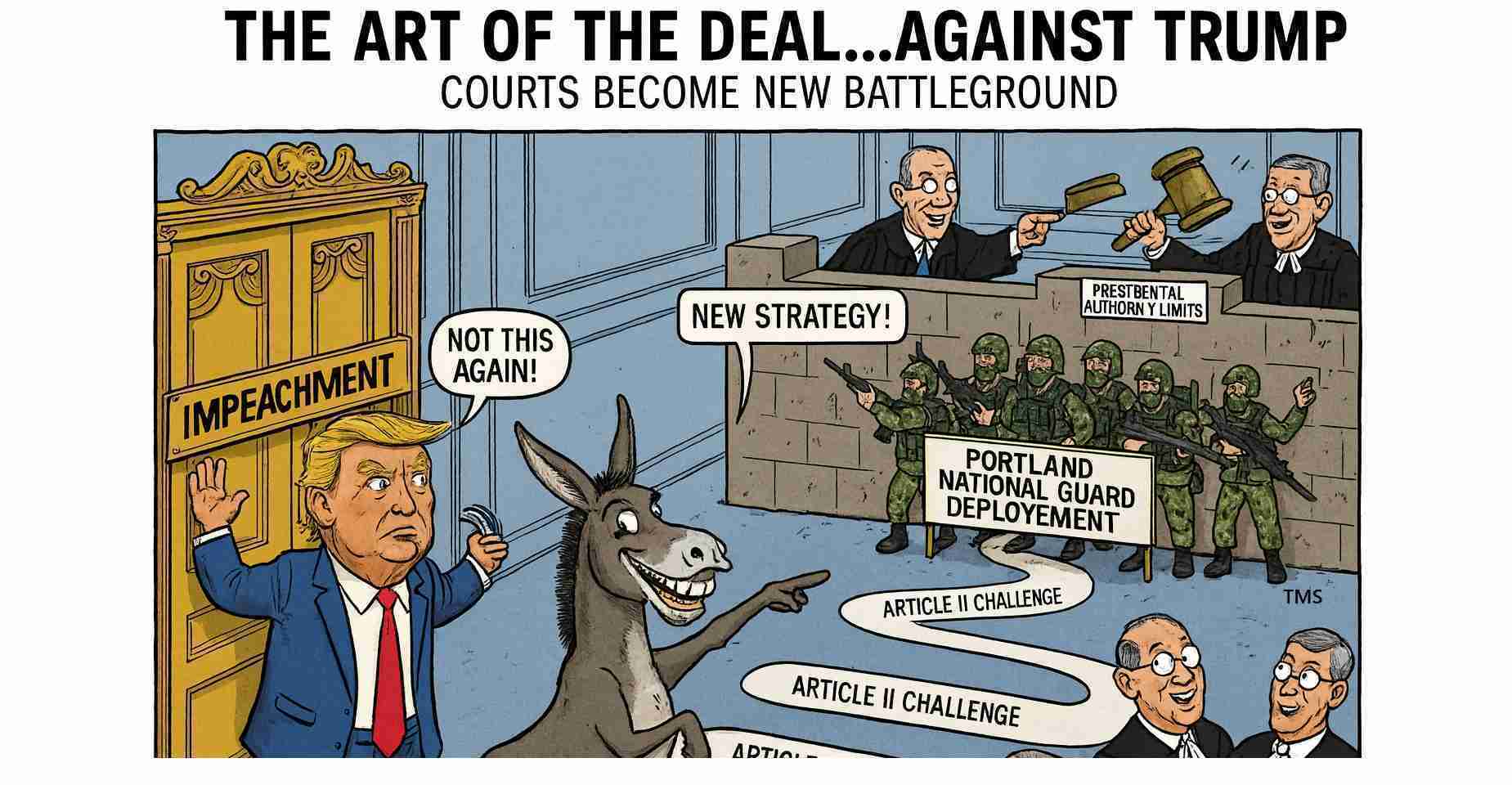
Democrats Shift Tactics: Article II Challenges, Court Battles and the Portland National Guard Deployment as a New Battleground
Democrats are shifting from impeachment to Article II challenges and federal litigation to constrain President Trump’s 2025 authority, increasingly using courts to block controversial executive orders and contest deployments such as the Portland National Guard.
Key takeaways
- Strategy change: Democrats are turning from impeachment to Article II challenges and lawsuits to limit presidential power (Just Security; American Progress).
- Judicial intervention: Federal courts have issued dozens of injunctions and restraining orders against administration actions, notably blocking some executive orders targeting diversity, equity and inclusion (Just Security; Callabor Law).
- Portland test: The Portland National Guard deployment is a focal test of presidential authority over federal forces and state consent (Just Security).
Main content
Why the strategy changed
Lawmakers and advocacy groups have increasingly turned to the judiciary because courts offer direct, binding remedies that can stop or slow executive actions faster than political routes. Instead of pursuing impeachment — a political, often divisive process — Democrats and allied organizations file suits arguing the president exceeded constitutional or statutory authority under Article II.
Legal filings frequently point to Article II’s limits and assert that many recent orders exceed what the president may lawfully do. For background and trackers see Just Security and the analysis at American Progress.
The flood of litigation
Federal court records and reporting document a rapid rise in cases challenging presidential directives. Advocates cite more than 100 lawsuits and at least 50 restraining orders or preliminary injunctions issued by federal judges contesting the administration’s interpretation of executive power (Just Security).
Many suits target rules that affect individuals’ rights or require agencies to change longstanding practices. Judges are being asked repeatedly to decide when presidential orders cross the line into unlawful action.
Federal courts block executive orders on DEI
A notable wave of litigation led federal courts to temporarily block the enforcement of January 2025 executive orders aimed at restricting diversity, equity and inclusion programs. A U.S. District Court in Maryland found several anti‑DEI provisions likely violated the First and Fifth Amendments, describing the orders as vague and amounting to viewpoint discrimination.
“The court held these provisions could force organizations to curb lawful speech or forgo federal money — raising both free speech and equal protection concerns.”
The orders under review included:
- Termination Provision: requiring agencies to end equity‑related grants or contracts.
- Certification Provision: forcing contractors and grantees to certify they do not run DEI programs alleged to violate federal law.
- Enforcement Threat Provision: giving the Attorney General power to launch civil compliance investigations targeting DEI initiatives.
See coverage at Callabor Law and the tracker at Just Security.
Portland National Guard deployment becomes a test case
Portland is the most visible battleground for Article II challenges. Plaintiffs contend that deploying federal forces, including the National Guard, into a state without state consent and using them for law enforcement risks violating state authority and statutory limits such as the Posse Comitatus Act.
Courts are being asked to clarify when presidential authority permits cross‑state deployments, whether congressional authorization is required, and whether domestic military use for policing is lawful. The tracker and analysis at Just Security provide ongoing updates.
Legal arguments and constitutional claims
Lawsuits use multiple legal approaches:
- First Amendment claims: arguing orders that penalize viewpoints or restrict speech are unconstitutional.
- Fifth Amendment claims: asserting denial of due process or equal protection.
- Article II and statutory limits: many suits allege the president acted without legal authority or contrary to statutes passed by Congress (see Callabor Law; University of Chicago News).
Judges as referees of presidential power
With a divided Congress and impeachment politically fraught, federal judges frequently act as referees in disputes over presidential authority. Courts can issue injunctions or restraints when plaintiffs show likely harm, pausing policy changes nationwide or in specific localities until full resolution.
Implication: high volumes of high‑stakes litigation may produce divergent lower‑court rulings, swift appeals to circuit courts, and potential U.S. Supreme Court review — outcomes that will shape Article II doctrine for years.
How advocacy groups and lawmakers are using the courts
Democratic lawmakers, civil‑rights groups and public‑interest lawyers have coordinated many filings. Their goals are practical: stop policies perceived as unlawful, protect civil liberties, and set precedents that limit unilateral executive action. Litigation can produce faster, legally binding remedies than political efforts alone.
What is still undecided
As of 2025 many orders and directives remain under judicial review. Courts have issued temporary blocks, but final rulings are pending in numerous cases. The central question is how far judges will draw lines around Article II — whether they will impose strict limits on troop movements and funding conditions or defer broadly to the executive and political branches.
Implications for The World
Economic impact: Global markets monitor U.S. legal fights because blocked executive orders can change trade, regulation, and business planning. International firms tied to U.S. grants or procurement may face sudden shifts if DEI or contracting rules are enjoined.
Political consequences: Court rulings that shape Article II limits influence how allies and democracies worldwide view executive power and civil‑military roles.
Social effects: NGOs, universities and community partners worldwide may see programs preserved or disrupted depending on litigation over funding conditions and viewpoint restrictions.
Cultural relevance: Decisions protecting viewpoint‑based funding restrictions may encourage similar claims in other democracies balancing free expression and public funding rules.
Practical applications: City leaders, universities, nonprofits and businesses that receive U.S. federal funding should monitor litigation that could affect grant conditions and procurement compliance.
Sources and further reading
- Just Security, litigation tracker on Trump administration legal challenges
- Center for American Progress, analysis of presidential powers and judicial checks
- Callabor Law, coverage of federal court blocking enforcement of anti‑DEI executive orders
- University of Chicago News, explainer on executive orders and legal basis
Reporting compiled from court filings, legal analysis and public records cited above.



