
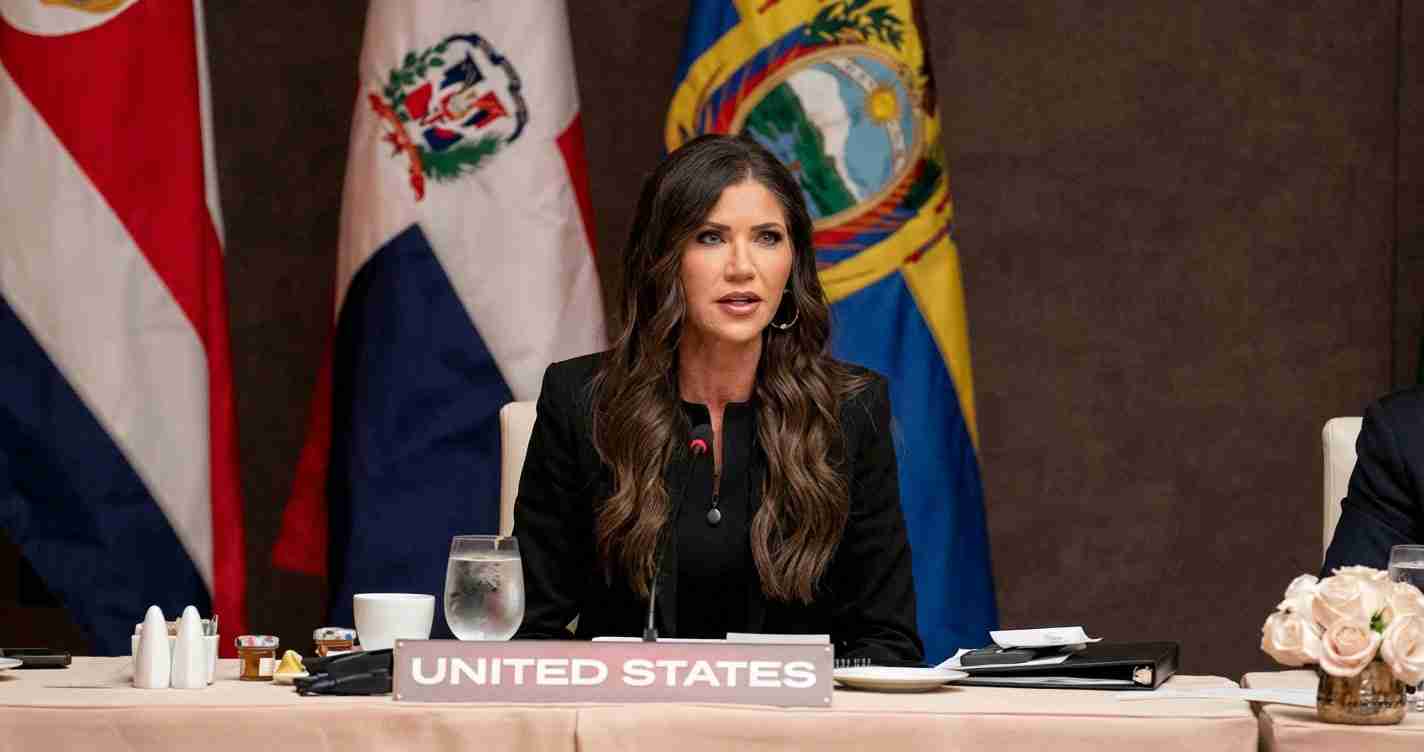
At Doral Summit, Shield of the Americas Draws Scrutiny as Reports About Kristi Noem Role Diverge
At the Shield of the Americas Summit at Trump National Doral on March 7, 2026, Kristi Noem attended and spoke as a political ally; reports suggesting she served as DHS secretary or a formal special‑envoy role are unverified.
Key takeaways
- Summit context: The Shield of the Americas Summit convened at Trump National Doral on March 7, 2026 to coordinate regional security, anti‑cartel efforts and counter foreign influence (U.S. State Department release).
- Noem’s presence verified: Reporting confirms Kristi Noem attended and spoke as an ally, but there is no verifiable evidence she served as U.S. Secretary of Homeland Security or that a formal “Special Envoy for the Shield of the Americas” post was created by the federal government (ABC News; WLRN).
- Policy framing: The administration linked the meeting to an assertive hemispheric policy labeled the “Donroe Doctrine,” aimed at limiting Chinese, Russian and Iranian influence (Politico).
What the Shield of the Americas summit was
Organizers billed the meeting as a compact of like‑minded governments focused on freedom, security and prosperity in the Western Hemisphere. The agenda included plans to share intelligence, coordinate law‑enforcement actions against cartels and reduce economic and political influence from China, Russia and Iran in Latin America. Analysts at the Center for Strategic and International Studies called the summit a vehicle to counter growing Chinese ties in the region (CSIS analysis).
The meeting drew right‑leaning leaders and strong pro‑Washington figures, such as Argentina’s Javier Milei and El Salvador’s Nayib Bukele. Critics described the event as a narrowly partisan alternative to the broader Summit of the Americas process and warned of human‑rights and sovereignty risks if military and police measures expand without oversight (WLRN; Democracy Now!).
How Kristi Noem appeared in reports
On‑site news teams noted Noem’s presence and quoted her remarks on cartel and narcoterrorism priorities. Some outlets relayed an account that President Trump would remove Noem as DHS secretary and move her into a new role as a special envoy for Shield of the Americas; that phrasing appears to reflect a political announcement rather than a published, legally formalized personnel action (ABC News; WLRN).
On the record: reporting confirms Noem attended and made public comments, but authoritative government personnel listings do not show her as DHS secretary or the creation of a formal “Special Envoy for the Shield of the Americas” office (U.S. State Department release).
Discrepancies and misinformation around “Kristi Noem Role”
Several circulating claims—most notably that Noem was “ousted” from DHS or that she recounted DHS removing “over 3 million people” in a year—do not match verified reporting. Those detailed operational claims and extended monologues were not reproduced in credible transcripts or major outlets and appear to be unverified or fabricated (Politico; WLRN).
What Noem did say, on the record
ABC News and on‑site reporting captured several of Noem’s on‑the‑record lines that foregrounded the summit’s anti‑cartel focus. She emphasized targeting cartels and narcoterrorists, offered to be available to partner leaders and, according to ABC, even shared personal contact to facilitate cooperation. Those remarks align with the summit’s stated focus on militarized and cooperative security measures across the hemisphere (ABC News).
Administration framing: the Donroe Doctrine
The administration tied Shield of the Americas to a broader doctrine now described in media as the “Donroe Doctrine”—merging historical Monroe Doctrine themes with a more interventionist posture. Officials framed it as stronger U.S. political and military engagement in Latin America to limit rival influence, pressure certain regimes, and secure strategic assets (Politico).
Reactions and analysis from analysts and civil society
Think tanks and regional media offered mixed reactions. CSIS analysts described Shield of the Americas as a vehicle to coordinate policy among aligned states and offer an alternative to China’s regional gains. Human‑rights groups warned the plan could accelerate militarized approaches to migration and drug policy and sidestep judicial safeguards. Independent and progressive outlets framed the summit as an ideological project with geopolitical aims that could destabilize local governance if implemented without checks (CSIS analysis; Democracy Now!).
Source notes and where reporting differs
- U.S. State Department release on hosting the summit
- CSIS analysis
- Politico coverage of Trump’s remarks and Donroe Doctrine context
- ABC News on‑the‑ground reporting and quotes from Noem
- Local reporting and context (WLRN)
- Critical perspectives (Democracy Now!)
Implications for the World
Economic impact
Shield of the Americas proposals to push back on Chinese investment could reshape trade and infrastructure markets across Latin America. Countries aligning closely with the U.S. security bloc may see shifts in investment flows and conditional aid tied to security cooperation. Global firms with interests in ports and natural resources could face new political risk where alignment becomes a factor in contracts (CSIS analysis; Politico).
Political consequences
The Donroe Doctrine’s assertive posture could heighten tensions with China and Russia and deepen polarization within countries in the hemisphere. Governments participating in Shield of the Americas may face internal opposition if security measures are perceived as eroding civil liberties, and European democracies may reassess hemispheric policy and human‑rights diplomacy approaches (Politico).
Social effects
A stronger focus on military operations against cartels risks civilian harm and migration shocks if operations displace people or destabilize weak states. Humanitarian groups caution that militarized campaigns without investment in rule‑of‑law and social programs can worsen conditions that drive migration and crime (Democracy Now!).
Cultural relevance
The summit and its rhetoric resonate with domestic political audiences in the U.S. and allied countries. For many Latin American voters, alignment with a U.S. security bloc tied to the Donroe Doctrine may revive memories of past interventions and provoke cultural pushback; European observers may see echoes of 20th‑century hemispheric politics.
Practical applications for governments and civil society
Governments that join or cooperate with Shield of the Americas will need clear legal frameworks for cross‑border operations and robust oversight mechanisms. Civil society organizations should press for transparency on intelligence sharing, extradition, and detention practices. International partners must monitor human‑rights impacts while engaging on transnational crime and migration in ways that respect legal norms (CSIS analysis; Democracy Now!).



