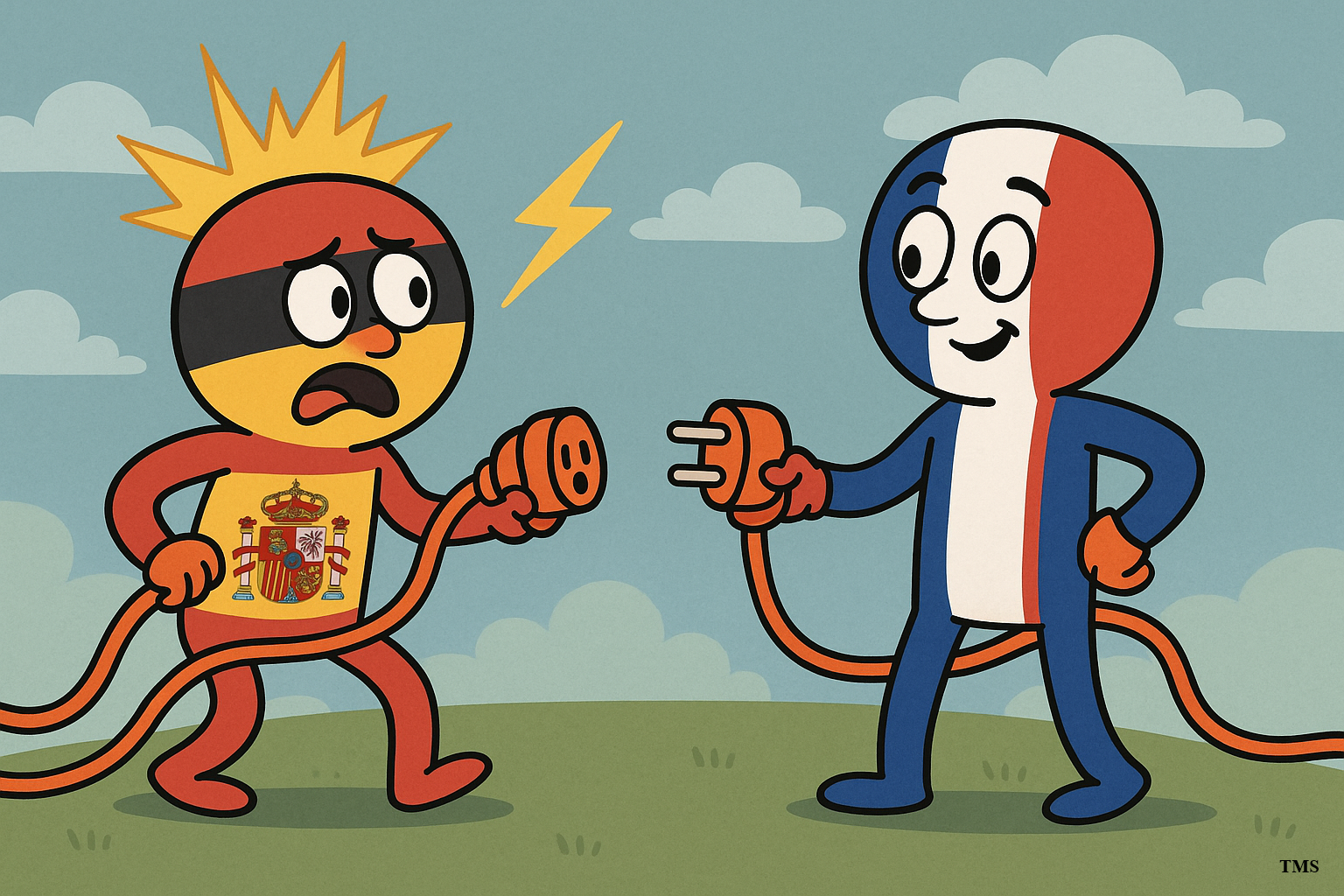
 Power outage In Spain electric power grid failure
Prompting Global Grid Security Questions – massive blackout leaves millions in the dark across Iberia, exposes vulnerabilities in modern electric grids, and raises concerns for California’s future
Iberian Peninsula, European Union (Times Media Service) – On April 28, 2025, the electric power grid in Spain and Portugal collapsed in an unprecedented blackout, leaving nearly 60 million people without electricity and paralyzing daily life across the Iberian Peninsula. The historic outage, which lasted up to ten hours in many regions, has sparked urgent debate about grid security and the risks facing other regions, including California.
How the Spain and Portugal Power Grid Failure Unfolded
The power grid failure in Spain and Portugal began suddenly at 12:33 p.m. local time on April 28. Within five seconds, the grid lost 15 gigawatts of power-about 60% of Spain’s electricity demand at that moment. The blackout quickly spread, impacting Portugal, Andorra, and parts of southwestern France.
Critical infrastructure, including transportation, telecommunications, and emergency services, was severely disrupted. Traffic lights failed, trains and airports halted operations, and businesses closed as ATMs and payment systems went offline. Hospitals switched to backup generators to maintain essential care.
Investigating the Cause: Who Is to Blame?
Authorities are still investigating the root cause of the blackout. Early reports from Spain’s grid operator, Red Eléctrica, and Portugal’s REN suggest that a complex sequence of events, possibly triggered by abnormal oscillations in high-voltage lines, led to the grid’s collapse. Some experts noted that extreme temperature variations may have caused “induced atmospheric vibration,” destabilizing the grid and causing synchronization failures with neighboring countries.
While Portugal’s Prime Minister pointed to a fault originating in Spain, Spanish officials highlighted a failure in the interconnection with France as a key factor. There is no evidence of a cyberattack or sabotage, but the rapid sequence of failures overwhelmed the system’s safeguards.
Could California’s Power Grid Face the Same Risks?
California’s electric grid shares some similarities with Spain and Portugal, including a high reliance on renewable energy and exposure to extreme weather. However, California has invested heavily in battery storage and regional energy sharing to improve resilience. Despite these efforts, experts warn that unexpected events-such as heatwaves, wildfires, or technical failures-could still challenge California’s grid security if not continually addressed.
Steps Needed to Prevent Future Blackouts in Spain and Portugal
To prevent another massive blackout, Spain and Portugal must:
- Upgrade grid infrastructure to handle rapid fluctuations in supply and demand.
- Expand cross-border connections to ensure backup support from neighboring countries.
- Invest in advanced monitoring systems and automation for faster response to grid instability.
- Increase battery storage and backup generation to manage renewable energy variability.
An international expert panel is currently investigating the incident and will recommend further technical solutions.
Lessons for California and Other Regions
California’s approach to grid modernization-focusing on battery storage, emergency reserves, and regional collaboration-offers a model for improving grid resilience. However, the Iberian blackout is a stark reminder that even advanced grids are vulnerable to unexpected failures. Continuous investment, innovation, and cross-border cooperation are essential to secure the electric power grid in an era of rapid energy transition.
Amelia Evans / World News Writer (Times Media Service)
aevans@timesmediaservice.com