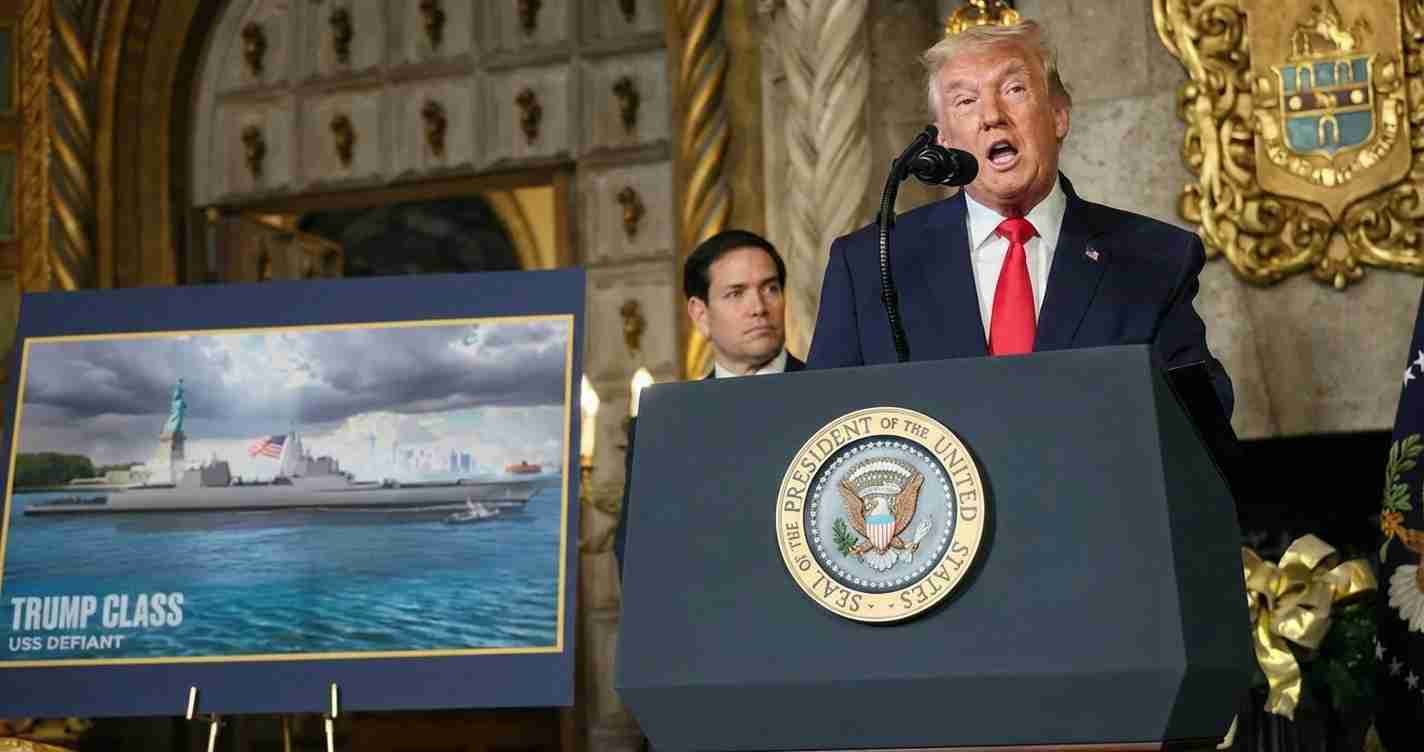
Trump unveils “Golden Fleet” at Mar-a-Lago, promises nuclear-armed battleships and rapid shipbuilding push
President Donald Trump unveiled a “Golden Fleet” at Mar-a-Lago on Dec. 22, 2025, proposing 20–25 new surface combatants described as nuclear‑armed and pledging the first two ships to be rapidly delivered within roughly 2.5 years.
Key takeaways
- Ambitious scale: Administration plans call for an initial procurement of two ships, rising to 10, and ultimately 20–25 vessels.
- Nuclear claims: The ships were described as nuclear-armed, though precise meaning (weapons vs. propulsion) was not specified.
- Timeline promise: The first two vessels are targeted within about 2.5 years, per the announcement.
- Details lacking: No formal designs, armament lists, propulsion plans, or procurement documents were released at the time of the rollout.
Main story
What Trump announced at Mar-a-Lago
On Dec. 22, 2025, at his Mar-a-Lago estate, President Trump introduced a public, full-surface‑warfare initiative he called the “Golden Fleet.” Flanked by Secretary of War Pete Hegseth and Secretary of the Navy John Phelan, he framed the plan as a fast, large-scale program to restore and expand U.S. seapower with ships “built in the United States by American workers.”
Watch the video of the December 22 event at Mar-a-Lago and review mainstream coverage such as CBS News coverage for the rollout and political context.
Scope and timeline
Officials described a stepped procurement plan: immediately acquire two ships, accelerate to 10, then expand to between 20 and 25 total ships. The administration set an early public target of delivering the first two vessels within roughly 30 months.
Source reporting on the announcement and timeline includes the Mar-a-Lago video and news coverage such as CBS News.
Ship specifications and open questions
Early reporting and naval-technology outlets characterized the vessels as large, heavily armed surface ships. Terms used in coverage range from “battleships” to a new frigate class or even a bespoke “Trump class.” Naval News reported claims that the ships would be nuclear-armed and among the most powerful surface warfare ships aside from submarines, but it also noted that technical details remain thin.
Key unresolved questions include:
- What exactly “nuclear-armed” will mean for these surface ships.
- Whether they would carry strategic nuclear weapons, tactical nuclear munitions, or use nuclear propulsion.
- How the vessels would integrate into existing Navy force structure, legal frameworks, and treaty obligations.
“No detailed armament lists, propulsion plans, or confirmed ship designs have been released by the White House as of this reporting.”
Strategic context and timing
Trump presented the Golden Fleet as a response to perceived gaps in U.S. naval capacity amid heightened maritime activity from the Atlantic to the Indo‑Pacific. The administration cited recent naval moves in Latin America — including intensified posture and reported vessel seizures — as part of the rationale for expanding surface forces.
Officials also framed the program as an answer to years of slow shipbuilding, aiming to rebuild industrial capacity and create American jobs. Yet experts warn that rapidly building many large combatants will strain shipyard capacity, require sustained funding, and demand major workforce and supply‑chain expansions.
Procurement plans and the promise of speed
At Mar‑a‑Lago, aides described a rapid production concept: immediate procurement of two ships, scaling to 10, then expanding to 20–25. The public target for delivery of the first two ships is about 2.5 years. However, no formal Navy procurement documents or Congressional budget requests tied to these ships were posted at the time of the announcement, creating practical and legal questions about financing, design, and weapons integration.
Conflicting labels and media coverage
Media and analysts used differing labels — some invoked historical weight by calling them “battleships,” while others referred to a new frigate class. Mainstream outlets emphasized the political rollout and the figures present, while defense-technology outlets focused on size and reported nuclear capability. The White House had not released a detailed fact sheet to reconcile these differences.
Implications for The World
Economic impact
If formalized, the Golden Fleet could shift global shipbuilding markets, boosting U.S. yards and suppliers, creating jobs, and increasing demand for materials and systems. European builders may face new competition or partnership opportunities. Conversely, mass production risks cost overruns and supply bottlenecks that could slow other defense projects.
Political consequences
Allies will demand clarity on mission sets and any nuclear roles. If surface vessels are declared nuclear-capable, diplomatic debates over arms control, nonproliferation, and escalation risks are likely. European capitals and NATO members will seek consultations, treaty assessments, and coordinated planning before major deployments.
Security and military balance
A sudden expansion of large surface combatants could alter regional balances in the Indo-Pacific, Mediterranean, and Atlantic. Surface ships are vulnerable in some scenarios compared with submarines and air power, so operational concepts, basing, and command arrangements will shape how militaries respond to the new force posture.
Social and cultural effects
U.S. shipyard communities could see increased industrial activity, training, and local investment. Internationally, the rhetoric of a “Golden Fleet” and a Mar‑a‑Lago shipbuilding plan may spark debates about militarization, national priorities, and the tradeoffs between defense spending and domestic programs.
Practical effects for governments and citizens
Governments will request technical briefings before shaping policy. NATO and allied defense ministries are likely to demand details on capabilities, basing, and command structures. Citizens should anticipate parliamentary debates and media scrutiny over cost, legality, and strategic necessity.
What to watch next
Key follow-ups include publication of formal procurement documents, budgets, and technical specifications by the White House and the Navy. Congressional committees will likely review funding and legal issues. Independent analysts will monitor shipyard capacity, workforce plans, and whether the term “nuclear-armed” refers to weapons, propulsion, or other capabilities.
Source links and where to watch the announcement
- Video of the December 22 event at Mar-a-Lago: Video of the December 22 event at Mar-a-Lago
- CBS News coverage of the announcement and context: CBS News coverage
- Naval News analysis noting nuclear armament reporting: Naval News analysis
Reporting note: This article preserves original facts and sourcing from the event video and contemporaneous reporting by CBS News and Naval News.