
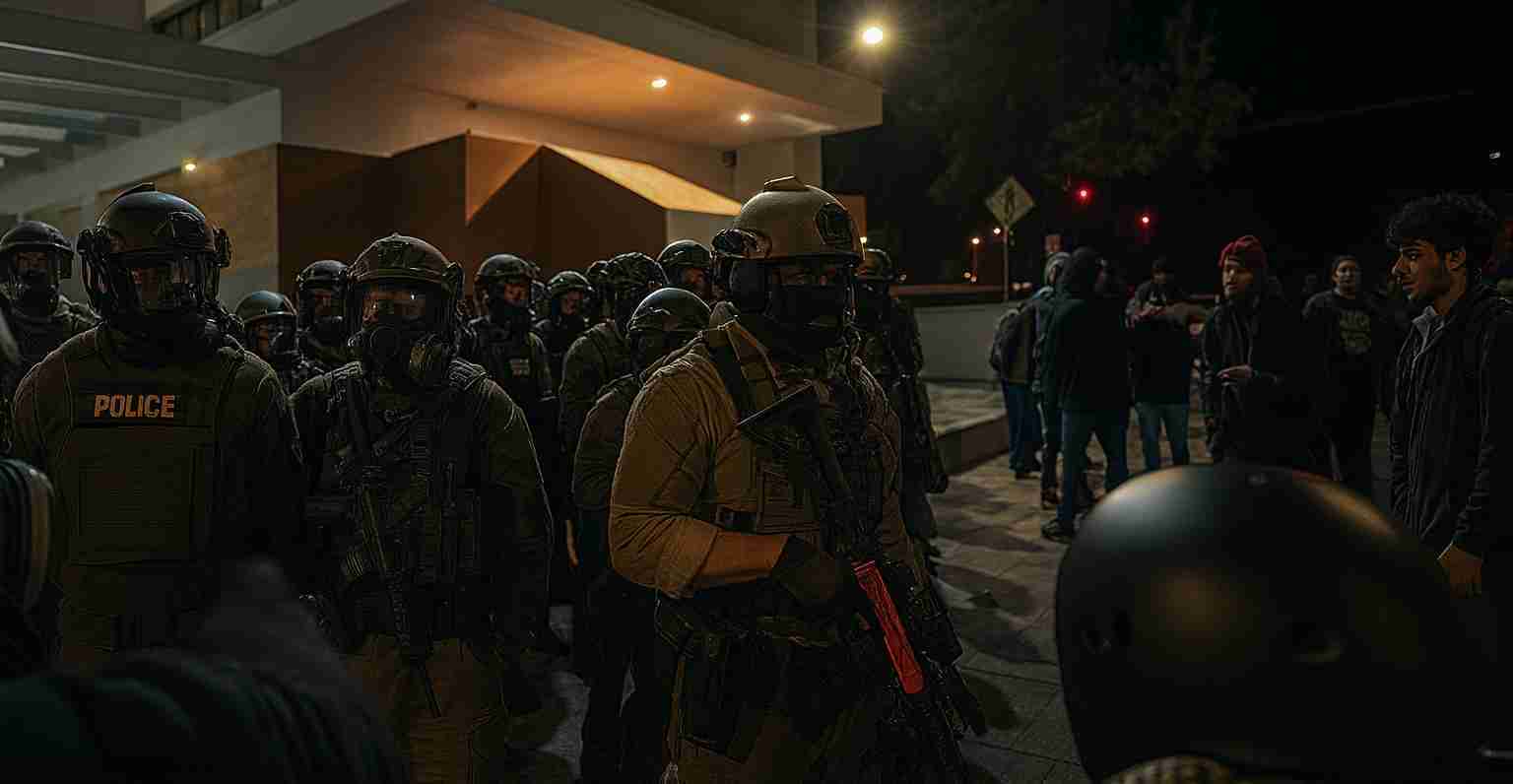
Ninth Circuit rules Trump can deploy National Guard to Portland in 2-1 stay of lower court block
The Ninth Circuit Court of Appeals issued a 2-1 stay allowing President Trump to federalize Oregon National Guard troops and deploy them to Portland, overturning a lower court block and intensifying debate on executive power, states’ rights and protest policing.
- Stay issued: The Ninth Circuit stayed the district court order that had blocked the plan to federalize Oregon National Guard troops and send them to Portland.
- Panel split: Two Trump appointees formed the majority while Judge Susan Graber, a Clinton appointee, dissented.
- Deference vs. rights: The majority emphasized judicial deference to the President’s judgment and the need for troop deployment, while critics warned of federal overreach and First Amendment threats.
- Pending limits: A separate district-court order with partial restrictions remains; the DOJ is expected to move to seek its dissolution (local reporting).
What the court said and why it matters
Last week a three-judge Ninth Circuit panel stayed a district judge’s order that had barred the federal government from federalizing Oregon’s National Guard for deployment to Portland. The majority said the lower court had improperly substituted its view for the President’s judgment about the facts on the ground and the need for federal forces.
Judges Ryan Nelson and Bridget Bade, in the majority, wrote that courts should give strong deference to the executive when it assesses domestic security threats. That posture cleared a path for the White House to advance what coverage calls the Trump National Guard Portland plan, at least while appeals proceed.
Dissenting view: state authority and protest rights
“Absurd,” Judge Susan Graber wrote in a pointed dissent, warning that the majority’s approach risks eroding the constitutional balance between federal and state authority over militias and threatens First Amendment protections.
Graber stressed that there was little factual support showing recent protest conduct that would justify federalizing the Guard and expressed concern that appellate intervention was premature. She argued the district court had sound reasons to block the deployment and that the appellate stay lacks the necessary factual underpinning (federalizing the Guard).
Legal and procedural context
The dispute began when the Trump administration announced it would federalize Oregon National Guard troops and send them to Portland, saying it was needed to protect federal property and federal law enforcement, including an ICE facility near parts of the city that had seen protests.
Oregon’s governor and Portland officials sued to stop the plan, arguing the federal government cannot commandeer state troops over a governor’s objection for operations within the state. A district judge initially blocked the plan; the Ninth Circuit’s stay reverses that block for now.
A second district-court order imposes partial limits that remain on the books. Legal observers expect the Department of Justice to press quickly to lift those constraints, citing the appellate stay and the federal interest in protecting officers (civil litigation updates and local reporting).
Reactions from civil rights groups and local leaders
The ACLU condemned the ruling as deeply troubling and said it would continue to challenge the deployment in court, warning that placing state National Guard troops under federal control for protest operations risks violating civil liberties and setting a dangerous precedent (ACLU statement).
Portland and state officials have repeatedly objected, saying protests had been largely peaceful recently and accusing federal authorities of inflating threats to justify a show of force. Local leaders and residents fear militarization could chill speech and escalate tensions (analysis local coverage).
What comes next in the courts
Judge Graber’s dissent invites potential rehearing requests by the full Ninth Circuit (an en banc review) or further appeals to the Supreme Court. The Department of Justice is expected to ask the district court to lift remaining restrictions, while civil liberties groups will likely file prompt challenges in response (ACLU).
Local angle: what Portlanders can expect
If remaining legal limits are dissolved, Oregon National Guard troops could be federalized and arrive to support federal agents. That may increase federal presence around protest sites and federal facilities, with tangible effects on daily life, businesses and public perception of safety (local reporting).
Community trust is a major concern: many Portlanders worry federalizing the Guard will escalate tensions rather than calm them. Businesses near protest areas face uncertainty about foot traffic and safety, and local law enforcement must navigate coordination with federal forces while respecting city policies and civil liberties.
For protesters, the decision raises questions about where and how they can safely express dissent. Civil liberties groups say a federalized Guard presence could chill free speech and discourage lawful protests by raising the stakes for large gatherings.
Implications for the World
The Ninth Circuit ruling has lessons beyond Oregon. Democracies watch how the United States balances federal authority, state power and citizens’ rights during unrest:
- Executive power and checks: The case highlights judicial approaches to deferring to the executive on domestic security, a dynamic other countries monitor for guidance on emergency powers and civilian control of military forces (analysis).
- Protest rights and civil liberties: Observers may see this as a test of how strongly courts protect free assembly and speech protections when governments cite security needs (ACLU response).
- Federalism as a model: The dispute underscores tensions when national leaders seek to override subnational authorities; nations with strong regional governments will note the legal reasoning used here (coverage).
- International perception: How the U.S. handles protests affects its image abroad and feeds debates about democratic norms, the rule of law and civil-rights protections (reporting).
- Practical consequences for global actors: Multinational firms and foreign missions monitor domestic security risks; increased federal troop presence can affect travel, operations and risk assessments (local analysis).
Sources and further reading
- Democracy Docket: Coverage and analysis of the Ninth Circuit decision
- Oregon Public Broadcasting: Reporting on the court’s action and local reaction
- ACLU: Statement on the Ninth Circuit opinion permitting the deployment
Reporting contributed by Times Media Service.


