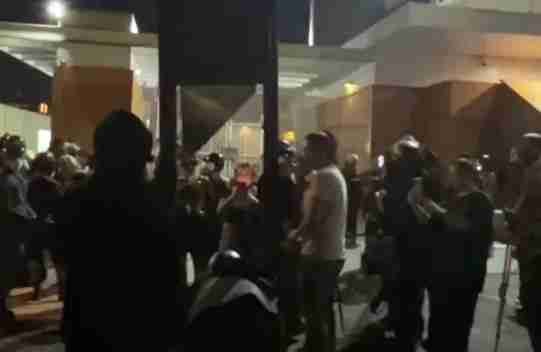
ICE director says Portland facility has faced 100+ nights of attacks as federal agencies target Antifa-linked groups; Trump orders 200 National Guard troops
Portland’s ICE facility has faced over 100 nights of attacks—rockets, rocks and lasers—federal officials say, amid doxxing and follow‑home threats. President Trump ordered 200 National Guard troops to protect federal property and personnel amid increasing tensions.
- Nightly assaults: ICE director Cammila Wamsley reports more than 100 consecutive nights of attacks involving rockets, rocks and lasers. (Times of India)
- Targeting and doxxing: At least six ICE employees have been doxxed and some agents report being followed from work to home. (Times of India)
- Federal legal action: The U.S. Attorney’s Office and the Department of Justice are using subpoenas and criminal charges to pursue suspects. (U.S. Department of Justice)
- National Guard deployed: President Trump ordered 200 National Guard troops to protect federal property and personnel in Portland. (Times of India)
Rising attacks on the ICE site
Portland’s ICE facility has become a nightly flashpoint, according to agency leadership. Local ICE director Cammila Wamsley told federal officials the building and its staff have faced repeated assaults for more than 100 consecutive nights — including small rockets, thrown rocks and lasers aimed at officers and cameras. (Times of India)
“The building and its staff have faced repeated assaults for more than 100 consecutive nights,” federal officials summarize the situation.
Federal view: Antifa-linked groups and organized tactics
Federal departments, including the Department of Homeland Security, characterize the violence as coordinated rather than purely spontaneous. Officials assert that groups linked to Antifa are organizing direct actions and property damage around the ICE building, prompting multi-agency investigations. (Times of India)
Targeting, doxxing and staff safety
Federal staff describe a pattern of planned, persistent actions that go beyond sporadic protests. Officials report at least six ICE employees have been doxxed, and some agents say they were followed from work to their homes, increasing fear among staff and calls for enhanced protection. (Times of India)
Law enforcement response and legal moves
Federal prosecutors have moved beyond warnings. The U.S. Department of Justice and the U.S. Attorney’s Office in Oregon announced criminal charges in at least one case tied to attacks near the ICE office, charging a Portland woman with assaulting a federal officer. Administrative subpoenas and other tools are being used to identify and prosecute those accused of violent acts.
The federal effort includes digital and physical evidence collection, with prosecutors signaling court action as the primary path to accountability rather than local restraining measures. (U.S. Department of Justice)
Allegations against local police and city leaders
Federal leaders claim Portland police have not provided adequate support to protect federal personnel and installations, and that city leaders have restricted police action at the site. City officials and local law enforcement, in turn, emphasize limits on force and the protection of protesters’ rights, citing political and legal pressure following earlier high-profile encounters.
Those tensions have complicated federal-local cooperation and fueled public debate over policing tactics during sustained protests.
National Guard deployment and federal-local tensions
President Trump ordered 200 National Guard troops to Portland to protect federal property and personnel. Federal officials said the Guard would bolster security and strengthen perimeter presence around federal facilities. Critics warn that military forces in cities can escalate confrontations and blur law enforcement roles, while supporters view the deployment as a measured step to prevent damage and protect people. (Times of India)
Targeting and investigation of organizers
Federal agencies are focusing on people and networks they believe are linked to Antifa. Investigators are tracing online activity, collecting evidence of doxxing, and using administrative subpoenas to obtain social media posts, communications and records that could tie individuals to violent acts near the ICE facility. (U.S. Department of Justice)
Civil liberties groups caution about broad sweeps and the risk of misidentifying peaceful protesters; balancing safety and constitutional rights remains a central legal and political question.
On-the-ground effects: staff safety and community strain
The doxxing of ICE employees has had real consequences: staff report fear for personal safety and their families. Encounters of agents being followed home have intensified the sense of vulnerability. Daily security duties have taken a toll on morale and operational capacity, federal officials say. (Times of India)
Local businesses and residents near the site report disruptions from nightly gatherings, increased security presence, and repeated law enforcement actions, further polarizing debate in Portland.
Implications for The World
Economic impact
Cities hosting federal offices or detention centers may see reduced foot traffic, harm to small businesses and tourism impacts when unrest persists.
Political consequences
The Portland stand-off highlights national-local tensions over public order and raises questions about the use of military forces in cities and federal authority during mass protests.
Social effects
Sustained unrest deepens social divides; doxxing demonstrates how digital tools can increase real-world risk for individuals.
Practical applications
Clear agreements on responsibilities, communication and thresholds for additional security, plus transparency about legal steps, can help cities and national governments manage similar crises.
Ongoing investigations and reporting
Federal prosecutors and investigators continue to gather evidence and pursue cases tied to violence outside the ICE office. Local and federal officials remain in a tense standoff. News outlets and public records will track arrests, legal filings and policy changes as the situation develops. (U.S. Department of Justice; Times Media Service)
Sources: Times of India / Times Media Service; U.S. Department of Justice